
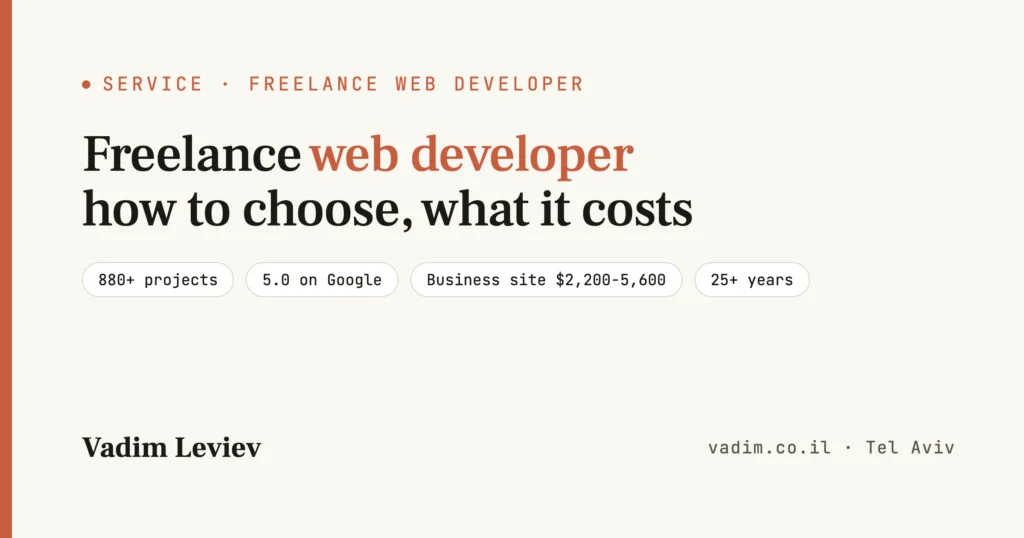
When you look for a freelance web developer you usually find two extremes: someone who assembles an Elementor template in a day, or an agency asking for a big budget. Both can be right - and both can be a complete waste of money, depending on what you need. 25+ years of building in production taught me one thing: the website isn't the product. Its business result is.
Freelance web developer or template assembler: what's the difference?
The market is full of headlines. Everyone is "professional", everyone is "experienced", everyone "builds sites that deliver results". So what really separates someone who assembles templates from a developer who builds systems?
| Trait | Template assembler | Professional developer |
|---|---|---|
| Approach to the problem | Picks a template that looks good | Understands the business need and builds for it |
| Code | Elementor or a page builder, broken CSS | Clean code, semantic HTML, measurable performance |
| Performance | Lighthouse 40-60, 4-8 seconds to load | Lighthouse 90 or above, under 2 seconds to load |
| Security | A security plugin and a prayer | Server hardening, penetration tests, real backups |
| Maintenance | Manual plugin updates, frequent breakdowns | Automation, monitoring, alerts before there is a problem |
| Scalability | Rebuild when the site grows | Architecture that holds for years ahead |
Who really needs a web developer for hire - and who can get by with Wix?
I'll say something most page-builder freelancers and agencies won't: not everyone needs a professional developer. Wix, Squarespace and WordPress.com are excellent for some cases. But there's a point where these tools become a limit - and recognizing that point saves you money.
| Type of business or need | Recommendation |
|---|---|
| A digital business card, 3-5 pages, static content | Wix or Squarespace - save your money |
| A personal blog, a simple portfolio | WordPress.com or Wix - completely enough |
| An online store with up to 50 products | Basic Shopify - saves 3 months of development |
| A business website that wants to grow through SEO | A professional developer - Wix is not enough for serious SEO |
| A store with complex logic, inventory, ERP | A full-stack developer - connections Shopify does not make |
| A SaaS system, a dashboard, a client portal | Definitely a developer - this is not a "website", it is an application |
| A site that needs serious performance, security and maintenance | A professional developer with production experience |
What a freelance web developer actually does, step by step
Professional website development is much more than "design and upload". It's building a digital product. This is what a proper build looks like:
What's the site's business goal? Who is the audience? What path does a user take from arrival to purchase? Without clear answers, every design is a guess.
Choosing the stack (WordPress? React? Next.js?), the database structure, the hosting and the performance plan - for the expected growth, not only for what works today.
Design that leads the user to the action you want. Not just "looks good", but wireframes, a clear hierarchy and calls to action in the right places.
Clean code, connections to external APIs (CRM, payments, management tools), modular building that's easy to maintain and extend.
Core Web Vitals, server hardening, SSL, caching, a sound URL structure, schema markup - everything Google and Lighthouse check.
A controlled deploy, automatic backups, uptime monitoring, security updates. The site doesn't end at launch - it starts there.
Production experience: what separates theory from reality
Many page-builder freelancers work only on small projects and have never seen what happens when a system collapses under load, when a hack wipes out years of content, or when an ERP integration breaks the whole checkout. My experience comes from a different place:
I was Tech Lead at William Hill Online - one of the largest betting companies in the world - on systems serving millions of users, then a developer at Mars Media Group and in senior full-stack development at BuyMe. When I build a site for a small or mid-sized business, I bring the same thinking: what happens at a peak? When the server goes down? When you need a feature nobody planned? That experience isn't in the CV - it's in the decisions I make at the planning stage. LinkedIn
5 common mistakes when choosing a web developer
- Choosing on low price alone
A cheap site that brings no leads costs more than an expensive site that produces income. The right price is a function of ROI, not of a catalog.
- Not checking real work samples
A pretty portfolio on a landing page says nothing about performance, code or maintenance. Ask for Lighthouse and PageSpeed scores of live sites.
- Not asking who will actually build it
Many agencies sell senior experience and hand the work to a cheap freelancer. Ask: who actually writes the code?
- Not thinking about what comes after launch
Maintenance, security updates, future changes - a site without support is a ticking bomb. What happens when something breaks at 3 a.m.?
- Confusing a pretty site with a profitable one
Design is a tool, not a goal. A site with Lighthouse 90 or above, a 1.5-second load and the right call to action brings more clients than a stunning site that loads in 6 seconds.
Website cost: what a freelance web developer charges
Everyone asks, and nobody answers directly. These are realistic prices, with what drives them (the full price list by type of site, with what each price includes, is on website development):
| Type of project | Price range | What is included |
|---|---|---|
| High-converting landing page | $330-970 | One page, custom design, basic SEO, a form |
| Business website (5-10 pages) | $2,200-5,600 | Custom WordPress, full SEO, integrations, warranty |
| Online store (WooCommerce) | $3,300-8,300 | Catalog, payments, inventory, invoices |
| Complex system or SaaS | from $8,300 | Custom architecture, API, dashboard, maintenance |
| Ongoing retainer | $420-1,100/month | Maintenance, updates, changes, monitoring and security |
Say a professional business website brings you 3 extra clients a month on average, and the whole project costs about what 7 or 8 average clients pay you. It pays for itself in under 3 months. A cheap site that doesn't convert costs you those 3 clients, every month.
7 questions to ask before you hire a web developer
- Can I see the Lighthouse scores of sites you built?
Performance is a measurable fact. If the developer can't show a score of 90 or above, it's not a site that will win on Google.
- Who actually writes the code - and on which platform?
A freelancer, Elementor, Wix or custom code? Each comes with pros and cons you should know in advance.
- What happens after launch - who handles breakdowns?
Most problems show up weeks after launch. What's the response time? Is there a maintenance contract?
- Will the site be fully mine - including the code?
Some agencies and page-builder freelancers lock you into their platform. Make sure there's a full code handover and access to every tool.
- Is SEO part of the build or an extra charge?
Technical SEO (URL structure, schema, sitemap, Core Web Vitals) has to be built into development - not "we'll add it later".
- What experience do you have with businesses like mine?
A developer who has built 50 sites in your field understands its particular needs - integrations, language, audience.
- What do you not do - and why?
A developer who knows their limits is an honest one. Someone who claims to do everything usually does nothing excellently.
Business website, store or sales page: which type of site fits you?
Not every business needs the same kind of site. A professional online store is completely different from a sales page or a business website, and the right choice saves money and speeds up the ROI:
| Type of site | Fits | Price range |
|---|---|---|
| Business website | Services, professional practices, B2B | $2,200-5,600 |
| Professional online store | Physical products, e-commerce, D2C | $3,300-8,300 |
| Sales page | A long sales page for a course or a digital product: copy, sections, testimonials and payment - not a single-message landing page | $830-2,200 |
| Portal or client system | SaaS, companies with a dashboard | from $8,300 |
AI website builders: do AI tools replace a professional developer?
AI website builders (Wix's AI builder, Framer AI, Durable and 10X Websites) produce a site within minutes. For some needs that's enough. For others it's an expensive mistake. As a developer who uses AI as a daily work tool, this is how I see it:
| What AI does well | What AI cannot do |
|---|---|
| A first design and basic structure within minutes | Custom code for unique business needs |
| Placeholder content for every page | Integrations with CRM, ERP and custom APIs |
| Quick design variations | Real performance optimization (Lighthouse 90 or above) |
| A prototype for a pitch deck | Security, maintenance and serious technical SEO |
I use AI (Claude, Copilot, Cursor) as a daily programming tool - it speeds up development 2-3 times. But AI writes code that looks right; an experienced developer knows what's wrong with it: security, performance, architecture. An AI website builder is an excellent assistant. It doesn't replace 25+ years of a developer's judgment.
Recommended web developer: what to look for in reviews
Google and Facebook reviews are full of 5-star ratings for web developers and agencies. How do you tell a genuine recommendation from a marketing one?
- Look for reviews that mention business results
"The site looks nice" is marketing. "I got 15 leads in the first month" is a result. A recommended developer proves it in ROI, not in screenshots.
- Check that reviews arrive over time
20 reviews that came in one week - suspicious. Reviews spread over two years - credible.
- Ask to talk to an existing client
A real professional will be glad to connect you with past clients. If the answer is no - what's there to hide?
Highly recommended! I have been working with Vadim for a while on everything from digital marketing to building a WordPress site, and I have no other word for it but "excellent". Professional, precise, available, and able to take an idea and turn it into a result that brings traffic, leads and sales. Beyond the impressive technical skills there is real marketing thinking, a deep understanding of the target audience, and attention to the small details that make the difference. If you are looking for someone you can trust with your eyes closed, who will promote your business online as if it were their own - this is the person. Recommended with all my heart!
Freelance web developer: frequently asked questions
How long does it take to build a professional website?
A landing page one to two weeks. A full business website (5-10 pages) 3-4 weeks. A WooCommerce store 6-10 weeks. A complex system 2-3 months. Every project gets a detailed schedule before work starts.
What is the difference between WordPress and Wix for a business?
Wix is excellent for businesses that do not need deep SEO, do not expect growth and do not need complex integrations. A professionally built WordPress site gives full control of the code, excellent performance and real scalability. For a business that wants to grow through SEO, WordPress is the choice.
Should I hire a freelancer or an agency?
An experienced freelancer usually means a better price, direct communication and flexibility. An agency has many skills under one roof, but is usually more expensive and comes with layers of management. Most important: know who actually writes the code and what experience they have.
Can I manage the site myself after it is built?
Absolutely - that is the point of WordPress. A professional handover includes training, documentation and an admin interface that lets you edit content without technical knowledge. Cosmetic changes you do yourself; technical changes with support.
What if I am not happy with the site?
Proper work includes approvals in stages, not a handover of a finished site. At every stage (wireframe, design, development) there is an approval before moving on. That way a mismatch is found early, before hours go into the wrong direction.
Does building a website include SEO?
Technical SEO - yes, it has to be built in: URL structure, meta tags, schema, sitemap, Core Web Vitals, mobile-first. Content SEO (writing articles, inbound links) is a separate service after launch. Both matter, but technical comes first.
Related services: PHP developer, fractional CTO and WordPress security.
Looking for a freelance web developer? Let's talk about your project.
A free 30-minute call, no obligation · reply within 24 hours
Book a free call