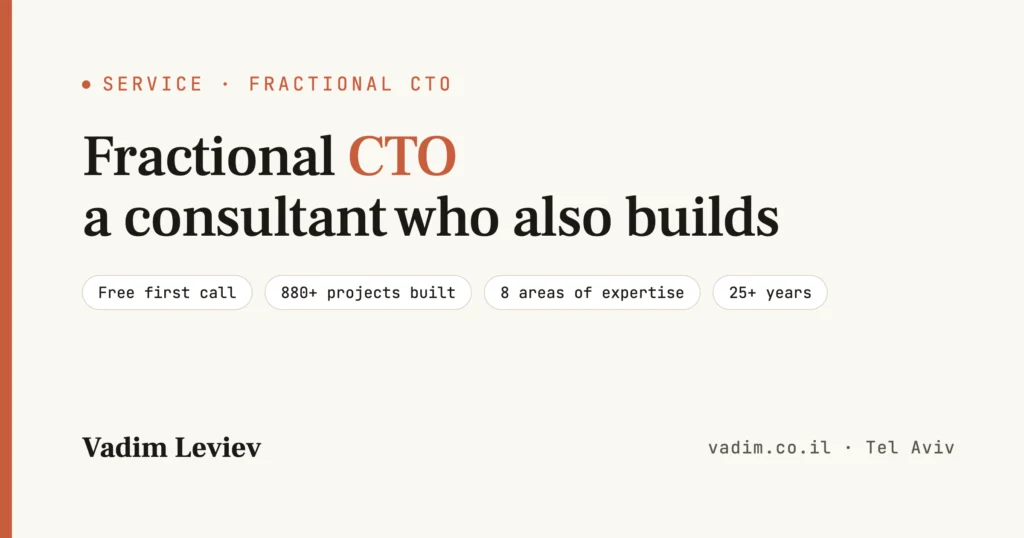
Many technology consultants can tell you what to do - but have never built it themselves. I'm a different kind of consultant: for 25+ years I've been writing code, building systems and leading teams in real production. My advice doesn't come from a slide deck. It comes from the experience of someone who has already made the mistakes, and already fixed them. When you get a recommendation from me, it's based on what actually works.
What is technology consulting?
Technology consulting is a process in which an experienced consultant helps a business make the right decisions about technology - which systems to build, on which architecture, which vendors to choose, how to move to the cloud, how to adopt artificial intelligence and how to protect your data. The goal is simple: save you time, money and expensive mistakes - and speed up growth.
The difference between good and not-so-good technology consulting isn't the number of slides. It's the ability to translate a business problem into a technology solution that really pays off. A good consultant won't sell you the newest technology, but the one that fits the need, the budget and the stage your business is at.
When does a business need a technology consultant or a fractional CTO?
Not every business needs technology consulting all the time - but there are moments when a wrong decision is expensive. These are the signs that it's time to get advice:
- You are about to make a big investment in a system or development
Before signing a large development quote, it's worth getting an independent opinion. One consulting day can save months of unnecessary development.
- Your development vendor says something and you don't know if it's true
When there's no technical person on your side, you depend entirely on the vendor. A technology consultant is your eyes - translating, checking and protecting your interest.
- The system is slow, crashes or can't grow
Performance and scalability problems are usually architecture problems. Focused consulting finds the root cause before you invest in more servers.
- You want to adopt AI and don't know where to start
Artificial intelligence is a huge opportunity - and a money pit when it's done wrong. Consulting focuses you on the places where AI really returns the investment.
- You have no CTO - but you need CTO thinking
Many startups and businesses don't need a full-time CTO, but senior technology guidance at the decision points. That's exactly what a fractional CTO provides.
What technology consulting covers
Comprehensive technology consulting touches several areas. Not every business needs all of them - part of a consultant's value is knowing what to focus on:
| Consulting area | What it gives the business |
|---|---|
| Digital strategy | A technology roadmap that serves the business goals - not technology for its own sake |
| Software architecture | Designing a system that holds up under load and stays cheap to maintain for years |
| Technology and vendor selection | Which language, framework, cloud and CRM fit - and an evaluation of vendors' quotes |
| AI implementation | Where AI returns a real investment, and where it is only buzz |
| Moving to the cloud | Planning a migration to AWS or GCP without surprises on the bill |
| Cybersecurity | Finding exposures before an attacker does - from experience in penetration testing |
| Building and managing a development team | Hiring, work processes and mentoring - so the team works right, not just hard |
The advantage of a fractional CTO who also builds
Many technology consultants on the market come from a management or academic background - they can talk about technology, but can't write a single line of code. The problem: a recommendation that was never tested in reality is an educated guess. I come from the other side - I built first, and only later started consulting.
As Tech Lead at William Hill Online, on systems serving millions of users, and later in development at Mars Media Group and senior full-stack development at BuyMe, I saw up close what happens when architecture decisions are made wrong - and the system collapses under load. When I recommend a solution, I know exactly how it will look in production, what it will cost to maintain, and where it will break. That's the difference between theoretical technology consulting and consulting from someone who has been there.
I also cover seven areas - from AI and cybersecurity to PHP and Laravel development, cloud and DevOps. So you get the whole picture from one person, instead of piecing together advice from five different vendors who each pull in their own direction.
My career - 25+ years of building real systems
I've been developing for 25+ years and haven't stopped. I built an online community back in 2003, led development as Tech Lead at William Hill Online, worked in development at Mars Media Group and in senior full-stack development at BuyMe. Along the way I've built 880+ projects for clients - from online stores to complex systems that serve tens of thousands of users. You can follow my full professional path on LinkedIn.
And unlike many consultants who stopped touching code long ago, I keep developing. Today I still take on truly complex tasks and solve hard problems across the stack: artificial intelligence, security, architecture, performance and cloud. It's not a hobby - it's what keeps my consulting connected to reality, instead of turning it into outdated theory.
The task isn't to develop something complex - the task is to make money. Technology is a means, not a goal. Many businesses waste budgets on impressive development that doesn't move the bottom line. I know not only how to build, but also how to streamline and leverage a technology business so that the technology produces real revenue. That's exactly the angle that separates consulting that wastes money from consulting that pays for itself many times over.
Technology consulting by stage: startup, small or medium business, established organization, founder before launch
The needs of a six-month-old startup and a long-established organization are completely different. This is how the consulting is adapted:
| Type of organization | Main need |
|---|---|
| Startup | Choosing the stack, MVP architecture, an external CTO at decision points |
| Small or medium business | Choosing systems, digitizing processes, support in dealing with development vendors |
| Established organization | Modernizing legacy systems, moving to the cloud and adopting AI |
| Founder before launch | Checking technical feasibility, estimating a realistic budget and timeline |
The process - what technology consulting looks like in practice
A free 30-minute call in which I learn about the business, the goals, the challenges and the budget. No obligation - and if I'm not the right person, I'll say so and point you in the right direction.
An in-depth review of the current state - systems, code, architecture, vendors and processes. This is where the real problems come to light, sometimes different from what you thought.
A clear document with prioritized recommendations - what's urgent, what's important, what can wait. It includes an estimate of cost, timelines and risks. Not theory - steps you can carry out tomorrow morning.
Optional, but this is where the big value is: supporting the execution with the team or the vendors, code review, and making sure the system is really built right. A consultant who also knows how to build stays with you to the end.
How a fractional CTO engagement is priced
The engagement follows one of four models, from a free call to a monthly retainer:
| Consulting model | Suitable for |
|---|---|
| Initial discovery call | Free - to see if there is a fit |
| Focused consulting day | A specific decision - choosing a technology, an opinion on a quote |
| Consulting project | A full mapping + a recommendations document for a business or organization |
| Ongoing support (retainer) | An external CTO - fixed monthly hours for continuous guidance |
The advantage of a senior independent consultant over a large consulting firm: you talk directly to the expert, without layers of management that raise the hourly rate and keep you away from the knowledge.
As a painter and spiritual artist, I received a complete package: a website that presents the work and its energy, advertising that reaches the right audience, and close guidance step by step. Everything was transparent, professional and fast - a real saving of time and budget.
Fractional CTO and technology consulting: frequently asked questions
What is the difference between a technology consultant and a development company?
A development company sells you development, so it has an interest in you developing. An independent technology consultant is only on your side: checking whether you need to develop at all, what the cheapest way is, and how to make sure that what a vendor builds for you is actually right. I offer both - but in consulting, the only interest is yours.
How long does technology consulting take?
It depends on the scope: a focused consulting day for a specific question; a consulting project with a full mapping usually takes one to three weeks; ongoing support continues as needed. You and I decide on the discovery call what fits.
Is technology consulting right for a small business too?
Absolutely. For a small business a wrong technology decision hurts even more - there is no budget to get it wrong twice. One consulting day before a large investment is often the best-value investment a small business can make.
Do you also implement the recommendations, or only advise?
Both, your choice. Some clients want only a recommendations document and carry it out themselves; others want me to support the implementation with their team or vendors. As a consultant who also builds, I can stay with you to the end - and that is exactly the advantage.
What is a fractional CTO (CTO as a service)?
It is a model in which a business or a startup gets senior, CTO-level technology guidance without hiring a full-time CTO. It fits companies at the stage where they need strategic thinking at decision points but cannot yet justify a full-time role.
Which areas do you consult on?
Digital strategy, software architecture, technology and vendor selection, AI implementation, cloud migration, cybersecurity, and building development teams. That breadth makes it possible to give the whole picture from one person.
Need to make the right technology decision? Let's talk it through.
A free 30-minute call, no obligation · reply within 24 hours
Book a free call